

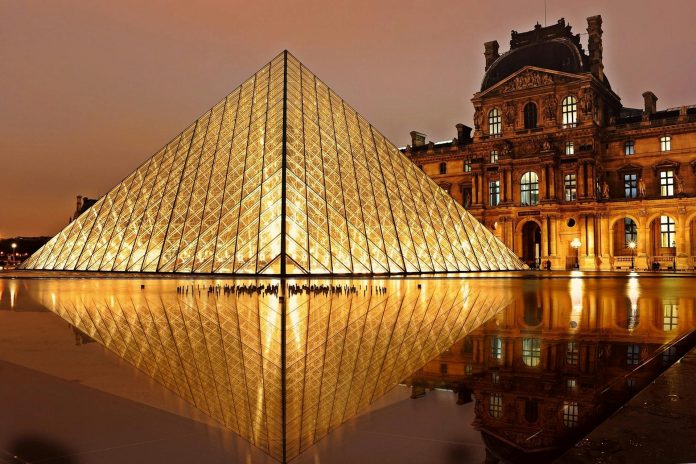

Discover the fascinating story behind the Louvre Pyramid Paris, the controversial glass structure that became one of the city’s most photographed landmarks. This guide explores its history, architecture, and significance as the gateway to the world’s most visited museum.
The birth of an icon
The Louvre Pyramid Paris stands as a brilliant juxtaposition of modern architecture against the classical backdrop of the historic Louvre Paris France. Designed by Chinese-American architect I.M. Pei and completed in 1989, the pyramid serves as the main entrance to the Louvre Museum Paris France. The project was commissioned by President François Mitterrand as part of his “Grand Louvre” renovation project to modernize the museum and improve visitor circulation.
Standing 71 feet (21.6 meters) tall and composed of 673 glass panes, the main pyramid is accompanied by three smaller pyramids surrounding a central courtyard known as the Cour Napoléon. The structure’s transparent design allows natural light to flood into the underground lobby while maintaining views of the surrounding palace architecture.
Controversy and acceptance
When first unveiled, the Louvre Pyramid Paris sparked fierce debate among Parisians and art critics. Many viewed the modern glass structure as an incongruous intrusion on the historic landscape of the former royal palace. Critics referred to it as a “scar on the face of Paris” and a “gigantic, ruinous gadget.”
Over time, however, the pyramid has become one of Paris’s most beloved landmarks, recognized globally as a symbol of the city alongside the Eiffel Tower and Notre-Dame Cathedral. Today, it’s difficult to imagine the Louvre Paris France without its distinctive entrance.
Architectural significance
The Louvre Pyramid Paris represents a masterclass in architectural problem-solving:
- Its transparent design ensures minimal visual obstruction of the historic palace
- The structure resolved major logistical issues by creating a central entrance point
- The underground lobby beneath the pyramid efficiently directs visitors to the museum’s three wings
- The glass panes are non-reflective, creating a clear view from both inside and outside
- The pyramid’s proportions were meticulously calculated to complement the surrounding architecture
Contrary to popular myth, the pyramid does not contain exactly 666 panes of glass (the “number of the beast” in biblical references). The actual count is 673 rhombus-shaped panes and 603 triangular panes.
Visiting the pyramid
When visiting the Louvre Pyramid Paris:
- The pyramid serves as the main entrance to the Louvre Museum Paris France
- Arrive early (before 9:30 AM) to avoid the longest lines
- Consider using alternative entrances like the Carrousel du Louvre shopping mall during peak times
- Visit at night to see the pyramid dramatically illuminated
- For the best photographs, visit early morning or during “blue hour” after sunset
- The pyramid is visible even without purchasing Louvre Paris tickets
Best times to visit
The Louvre Pyramid Paris area experiences different crowd levels throughout the day and year:
- Early mornings (before 10 AM) are ideal for photographs with fewer people
- Evenings offer spectacular illuminated views, especially during summer
- Winter months provide unique photo opportunities with occasional snow or fog
- Wednesday and Friday evenings see extended museum hours and interesting lighting conditions
Photography tips
For memorable photographs of the Louvre Pyramid Paris:
- Capture reflections in the water features surrounding the pyramid
- Frame the pyramid with the historic architecture for contrast
- Try unusual angles from the surrounding courtyard
- Visit after rain for dramatic reflections on the pavement
- Consider nighttime photos when the pyramid glows from within
Beyond the main pyramid
While visiting the Louvre Pyramid Paris, don’t miss:
- The inverted pyramid (“La Pyramide Inversée”) in the Carrousel du Louvre shopping mall below
- The three smaller pyramids surrounding the main structure
- The reflecting pools and fountains in the Cour Napoléon
- Views from the Tuileries Garden looking back toward the pyramid
- The Arc de Triomphe du Carrousel aligning with the pyramid
Practical information
- The pyramid and courtyard are accessible 24 hours a day
- The Louvre Museum Paris France entrance through the pyramid operates during regular museum hours
- Metro: Palais-Royal Musée du Louvre (Lines 1 and 7)
- The area around the pyramid is fully accessible for visitors with mobility challenges